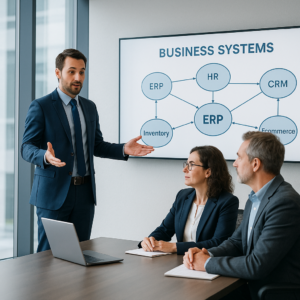
How to improve business efficiency starts with strategic IT planning that aligns technology investments with your operational goals. For UK small businesses, this means creating a structured approach to technology that reduces downtime, strengthens security, controls costs, and supports growth without overwhelming limited resources.
Key takeaways
- Strategic IT planning reduces operational risk by identifying vulnerabilities before they cause business disruption
- A well-structured technology roadmap typically delivers 15-25% improvement in productivity within the first year
- Proper IT budgeting prevents unexpected costs whilst ensuring critical systems receive adequate investment
- Regular assessment and measurement help businesses adapt their IT strategy as requirements evolve
- Risk management planning protects against cyber threats and ensures business continuity
Assessing current IT infrastructure and capabilities
Understanding where your business stands today forms the foundation of any effective IT strategy. This assessment reveals gaps, risks, and opportunities that directly impact how to improve business operations through technology.
Start with an inventory of all IT assets including servers, computers, software licences, network equipment, and cloud services. Document the age, condition, and business criticality of each component. Many small businesses discover they’re running outdated software or hardware that creates security vulnerabilities or performance bottlenecks.
Next, evaluate your current IT support model. Are you relying on reactive break-fix services, an overwhelmed part-time technician, or ad-hoc solutions? Map out response times for common issues, identify recurring problems, and calculate the true cost of downtime. This exercise often reveals that reactive support costs more than proactive management when you factor in lost productivity.
Security capabilities require particular attention. Review your backup procedures, password policies, software update processes, and access controls. Small businesses frequently underestimate their cyber risk exposure, yet a single security incident can cost thousands of pounds in recovery time and lost business.
Finally, assess your team’s IT skills and capacity. Can staff troubleshoot basic issues independently? Do you have clear escalation procedures? Understanding these human factors helps determine whether you need additional training, documentation, or external support to maintain operational efficiency.
Setting realistic IT objectives aligned with business goals
Effective IT objectives connect technology investments directly to business outcomes rather than pursuing technology for its own sake. This alignment ensures every pound spent on IT contributes to revenue growth, cost reduction, or risk mitigation.
Begin by identifying your business’s core operational challenges. Common issues include frequent system downtime, slow response to customer enquiries, manual processes that consume staff time, or difficulty accessing business data for decision-making. Each challenge represents an opportunity for technology to deliver measurable improvement.
Translate these challenges into specific, measurable IT objectives. Instead of vague goals like “improve efficiency,” set targets such as “reduce system downtime to less than 2 hours per month” or “automate invoice processing to save 10 hours weekly.” These concrete objectives make it easier to evaluate technology solutions and measure success.
Consider both immediate needs and growth plans. If you expect to hire additional staff or expand into new markets, your IT infrastructure must support that growth without requiring expensive emergency upgrades. Planning for scalability from the start typically costs less than retrofitting systems later.
Prioritise objectives based on business impact and implementation complexity. Quick wins that address pressing operational issues should come first, followed by longer-term strategic initiatives that support business development plans.
Creating a 3-year technology roadmap
A well-structured technology roadmap provides a clear path from your current IT state to your desired future capabilities. This roadmap helps you sequence investments logically, avoid costly missteps, and ensure all technology components work together effectively.
Year one should focus on stabilising core systems and addressing immediate risks. This typically includes implementing reliable backup solutions, strengthening security controls, ensuring all software receives regular updates, and establishing responsive IT support. These foundation elements prevent disruptions that could derail other business initiatives.
Year two often emphasises process improvement and business intelligence capabilities. Once core systems operate reliably, you can focus on automation opportunities, data integration, and reporting tools that support better decision-making. This phase might include implementing customer relationship management systems, financial reporting dashboards, or workflow automation tools.
Year three usually addresses advanced capabilities and strategic technology adoption. This could involve expanding cloud services, implementing advanced security measures, developing e-commerce capabilities, or integrating artificial intelligence tools that provide competitive advantages.
Build flexibility into your roadmap to accommodate changing business requirements or technology developments. Review and adjust the plan quarterly to ensure it remains aligned with business priorities and takes advantage of new opportunities.
What should you budget for IT investments and ongoing costs?
IT budgeting requires balancing necessary investments with cost control, particularly for small businesses with limited capital. Most UK SMEs should allocate 3-7% of annual revenue to IT expenses, though this varies significantly based on industry and technology dependence.
Capital expenditures typically include hardware purchases, software licences, and major system implementations. Plan for computer replacement every 4-5 years, server updates every 5-7 years, and network equipment refresh cycles of 7-10 years. Spreading these costs across multiple years prevents budget shocks and ensures systems receive updates before they become unreliable.
Operational expenses cover ongoing costs such as managed IT support, cloud service subscriptions, software maintenance, internet connectivity, and cybersecurity tools. These recurring costs often provide better value than one-off purchases because they include ongoing support, updates, and scalability.
Consider the total cost of ownership when evaluating options. A £500 computer might seem cheaper than a £800 model, but if the less expensive option requires replacement after three years instead of five, the premium model delivers better value. Similarly, managed IT services might cost more monthly than reactive support but typically reduce overall IT expenses through improved reliability and fewer emergency repairs.
Build a contingency fund equivalent to 10-15% of your annual IT budget for unexpected requirements or opportunities. Technology failures, security incidents, or sudden business growth can create urgent needs that benefit from immediate attention rather than waiting for the next budget cycle.
Risk management and contingency planning
Effective risk management protects your business against technology failures, cyber threats, and operational disruptions that could damage customer relationships or financial performance. Small businesses face the same risks as larger organisations but typically have fewer resources to recover from incidents.
Data backup represents the most critical risk mitigation measure. Implement automated daily backups with both local and offsite storage options. Test backup restoration procedures monthly to ensure data can be recovered quickly when needed. Many businesses discover their backup systems don’t work properly only after experiencing data loss.
Cybersecurity planning addresses increasingly sophisticated threats targeting small businesses. Essential measures include multi-factor authentication for all business accounts, regular software updates, staff security awareness training, and incident response procedures. Cyber Essentials certification provides a practical framework for implementing baseline security controls.
Business continuity planning ensures operations can continue during IT disruptions. Document critical systems, alternative work procedures, and communication plans for various scenarios. Consider which functions require immediate restoration versus those that can tolerate brief interruptions.
Vendor risk management becomes important as businesses rely increasingly on cloud services and external providers. Evaluate the financial stability, security practices, and business continuity capabilities of key technology suppliers. Maintain contracts that include appropriate service level guarantees and exit provisions.
Measuring IT strategy success and ROI
Regular measurement helps you understand whether IT investments deliver expected business benefits and identifies areas requiring adjustment. Effective measurement combines quantitative metrics with qualitative assessments of operational improvement.
Operational metrics track system performance and reliability. Monitor system uptime, help desk response times, security incident frequency, and user satisfaction scores. These indicators reveal whether your IT infrastructure supports business operations effectively or creates friction that hampers productivity.
Financial metrics assess cost effectiveness and return on investment. Calculate IT spending as a percentage of revenue, cost per employee for IT support, and savings from automation initiatives. Compare these figures to industry benchmarks and your historical performance to identify trends and opportunities.
Business impact metrics connect IT performance to broader organisational outcomes. Track improvements in customer response times, order processing efficiency, data accuracy, or decision-making speed that result from technology investments. These measurements demonstrate IT’s contribution to business success.
Review metrics quarterly and adjust your IT strategy based on results. If certain investments aren’t delivering expected benefits, investigate whether implementation issues, training gaps, or changing business requirements require modifications to your approach.
FAQ
How often should small businesses review their IT strategy?
Review your IT strategy quarterly for minor adjustments and annually for comprehensive evaluation. Business requirements and technology capabilities evolve continuously, so regular reviews ensure your strategy remains relevant and effective.
Should small businesses prioritise cloud migration or on-premises systems?
Cloud services typically offer better value for small businesses due to lower upfront costs, automatic updates, and built-in redundancy. However, assess your specific requirements including internet connectivity, data sensitivity, and compliance obligations before making decisions.
What’s the biggest mistake small businesses make with IT planning?
The most common mistake is reactive rather than strategic thinking. Many businesses wait until systems fail or security incidents occur before addressing IT needs, which costs significantly more than proactive planning and maintenance.
How do you know when to outsource IT management? Consider outsourcing when IT issues regularly disrupt business operations. You should also consider it when your internal team lacks necessary expertise. Another sign is when you’re spending more than 20% of staff time on IT-related tasks rather than core business activities.
Take the next step towards strategic IT planning
Strategic IT planning transforms technology from a business expense into a competitive advantage. By following this structured approach, you can reduce operational risks, control costs, and create technology capabilities that support business growth and improve business efficiency over time.
At ICT London, we help UK small businesses develop and implement practical IT strategies that deliver measurable results. Our consultative approach ensures your technology investments align with business objectives whilst providing the ongoing support needed to maintain optimal performance.
We can develop a strategic IT plan tailored to your business requirements. Contact our team to discuss how we can help you create a technology roadmap that supports your growth objectives and operational needs.